Bassikounou. 426 g

Bassikounou. 426 g. Collection

A fireball was witnessed at 04:00 local time in Bassikounou, a remote area in Hodh Ech Chargui, Mauritania. No records of the direction of movement were recorded. A single stone of 3165 gram was found by A. Salem El Moichine, a local resident, on the same day at 13:00, 11 km southeast of Bassikounou. The sample for classification was provided to NMBE by M. Ould Mounir, Nouakchott, who obtained it from his cousin who recovered the meteorite. Other specimens were found later on. These finds defined a 8 km long strewnfield. The total recovered mass was 46 kg. It is classified as an H5 chondrite. This specimen is 100% exquisite fusion crust and some lipping that can be seen in the first picture.

Bassikounou. 426 g. Collection

Ochansk. 374 g

Ochansk. 374 g. Collection

On the afternoon of August 30, 1887, a bright fireball was witnessed followed by several explosions near the town of Ochansk, Russia. Many people saw the fireball and subsequent fall of meteorites. This cement-grey chondrite fell over a large area with specimens of all sizes, the largest with a mass of 115 kg that now is in a museum in Tartarstan, Russia. Analysis showed the Ochansk meteorite specimens to be chondrites of the H4 type.

Ochansk. 374 g. Collection

Libyan Desert Glass. 1315 g

Libyan Desert Glass. 1315 g. Collection

Formed by a massive impact near the Libyan border with Egypt 26 million years ago, the Libyan Desert Glass impactite is one of the most sought after types.
Libyan Desert Glass was formed by a massive impact near the Libyan border with Egypt 26 million years ago. As a result of the heat and pressure of the impact event, sands were melted and formed an impact glass in a a wide range of shapes and colors from yellowish-white to yellow and black-yellow. Some pieces of Libyan Desert Glass contain meteoritic components but it does not have to do with their color. Some have aerodynamic features that resemble those of meteorites although they have been deeply wind-eroded.

Libyan Desert Glass. 1315 g. Collection

Zaragoza. 3 kg

Zaragoza. 3 kg. Collection

The Zaragoza meteorite was found around 1950 and sold to a mineral collector. Years later it was sold to a French dealer who sold it to American dealers. They cut it and offered it for sale. It weighed 162 kilos. Zaragoza is classified as an IVA-an iron and has a very fine and faint patter and some characteristic cracks near the surface. It is a very stable and hard iron. It is nice to get this slice back to Spain.

Zaragoza. 3 kg. Collection

Tunguska wood. 30 g

Tunguska wood. 30 g. Collection

The Tunguska event is a massive explosion that occurred on the morning of June 30, 1908 at around 07:17 local time in a remote region approximately 750 km northwest of Lake Baikal. Natives and Russian settlers in the hills northwest of Lake Baikal observed a column of bluish light, nearly as bright as the sun moving across the sky. About ten minutes later, there was a sound similar to artillery fire. The sounds were accompanied by a shock wave that knocked people off their feet, broke windows and some reports suggest that at least three people may have died in the event. It also flattened an estimated 80 million trees over an area of 2,150 km2 (830 sq mi) of forest. The explosion is generally attributed to the air burst (not impact itself) of a meteoroid about 100 meters in diameter that exploded at an altitude of 5 to 10 kilometres (3 to 6 miles). Due to the remoteness of the area, only a few expeditions reached the site. One of them was organized by the University of Bologna in 1991, when this wood plate was taken.

Tunguska wood. 30 g. Collection

Indochinite. 92 g

Indochinite. 92 g. Collection

Indochinites were ejected into the Earth’s upper atmosphere by a huge meteorite impact 788.000 years ago in the Gulf of Tonkin (Vietnam). The steam jets cooled down in the higher atmosphere and condensed to form this type of glass. The pieces rained down hundreds and thousands of kilometers away from the impact, in direction South-East, reaching Philippines and even Australia. They have diverse shapes and a characteristic black color. This “patty” indochinite has amazing flow lines radiating from the center of both faces.

Indochinite. 92 g. Collection

Sikhote Alin. 477 g

Sikhote Alin. 477 g. Collection

The Sikhote Alin meteorite is one of the biggest meteorite falls in recorded history. It was felt over 300km away with a bolide that the witnesses describe as brighter than the Sun. It crossed the atmosphere at 14km/s above the Sikhote Alin mountains. The fall happened in Russian fast East, close the the China border at 10:38 h local time the 12 February 1947. Sikhote Alin fragmented in its descent until the pressure of the atmosphere was so high that it exploded. The event left mainly 2 types of meteorites, one with smooth surfaces due to the higher time being ablated and one with intricate shapes due to the explosion. All these specimens are oriented and some have flow lines. They have been individually selected among many kilos of material.

Sikhote Alin. 477 g. Collection

Wiluna. 108 g

Wiluna. 108 g. Collection

On September 2, 1967 at 10:46 p.m. local time a large meteorite shower fell East of Wiluna in an elliptical area 5 x 3 kilometres. It is estimated that 500 to 1000 stones hit the ground. The Western Australian Museum has 480 stones and others are in private hands. The Wiluna meteorite is classified as an H5 chondrite meteorite. This specimen was recovered during the search organized by the Western Australia Museum shortly after the fall. The specimen bears the painted collection number 12934 137 which indicates the 137st individual collected from the Wiluna meteorite fall.

Wiluna. 108 g. Collection

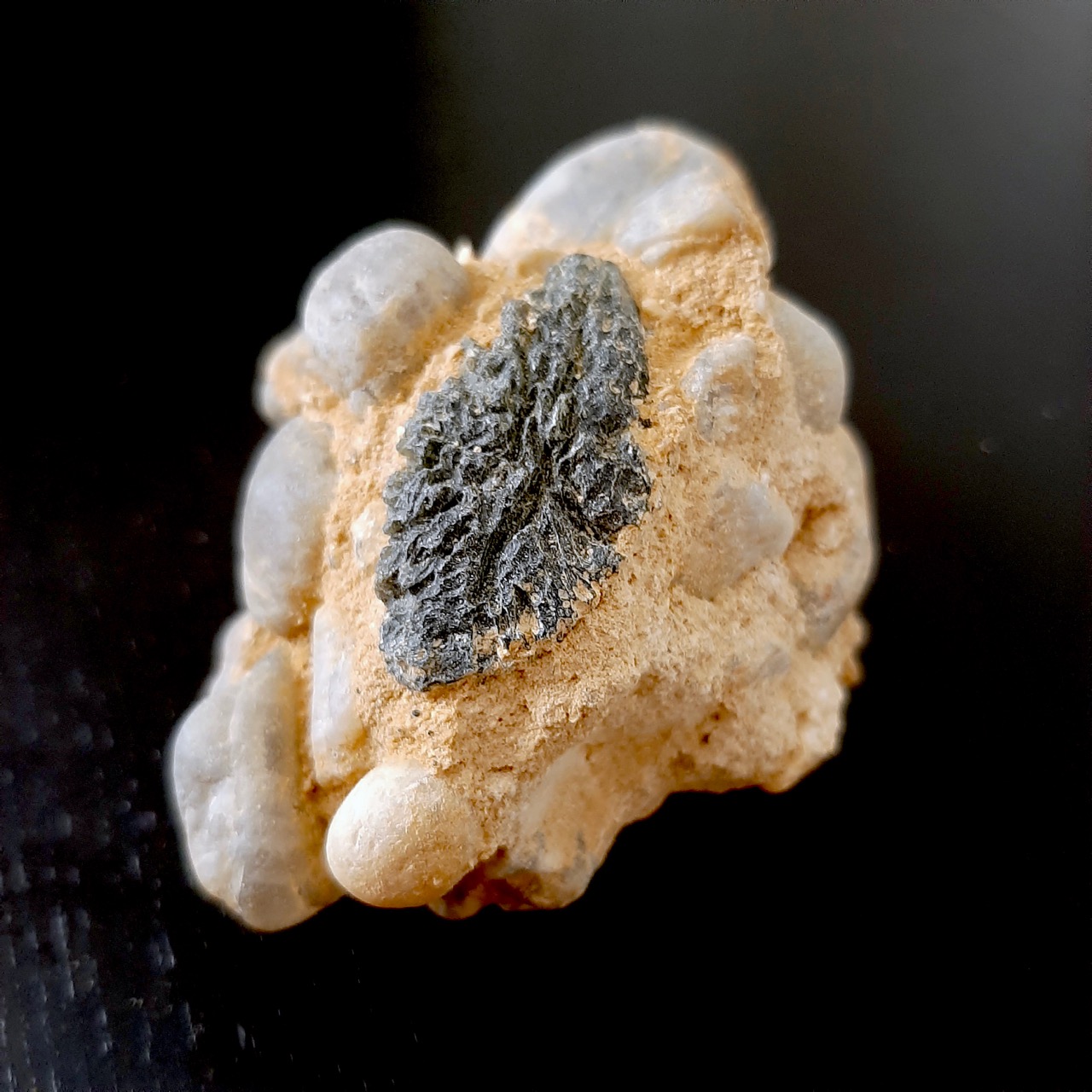
Moldavite. Total weight 230 g

Moldavite. Total weight 230 g. Collection

Moldavite glasses formed 15 million years ago during the impact of a giant meteorite in present-day Nördlinger Ries. Splatters of rocks that were melted by the impact cooled and most fell in south Bohemia – traversed by Vltava river, in German: Moldau, hence its name. They are a type of tektite and impactite. Although the event occurred in Germany, most specimens are found in Czech Republic due to the trajectory of the impact. This specimen is still on its original matrix.

Moldavite. Total weight 230 g. Collection
×