Iron meteorites

Iron meteorites come from the core of dead asteroids. Heavy metallic elements sank towards the center of these asteroids due to gravity. Collisions with other bodies then destroyed these asteroids, releasing their metallic cores to space. Iron meteorites are alloys, mainly of iron and nickel, although they also contain trace elements such as iridium. Iron meteorites account for only 4% of all observed meteorite falls, by number. However, due to their high density, the total weight of iron meteorites accounts for almost 50% of observed meteorite falls. This percentage increases up to 83% if the total weight of meteorite finds is included as well.

Iron meteorites.
Iron meteorite

Current scientific classification for iron meteorites is complex and exclusively dependent on the meteorite’s chemical composition. It includes 15 groups as follows: IAB, IC, IIAB, IIC, IID, IIE, IIF, IIG, IIIAB, IIICD, IIIE, IIIF, IVA, IVB, and Ungrouped irons. This classification is necessary for scientists as it is precise. There is a more visually intuitive classification that some collectors follow that is based on the internal structure. According to their structures, iron meteorites are classified into 3 types: octahedrites, hexahedrites and ataxites.

Iron meteorites.
Iron meteorite classification

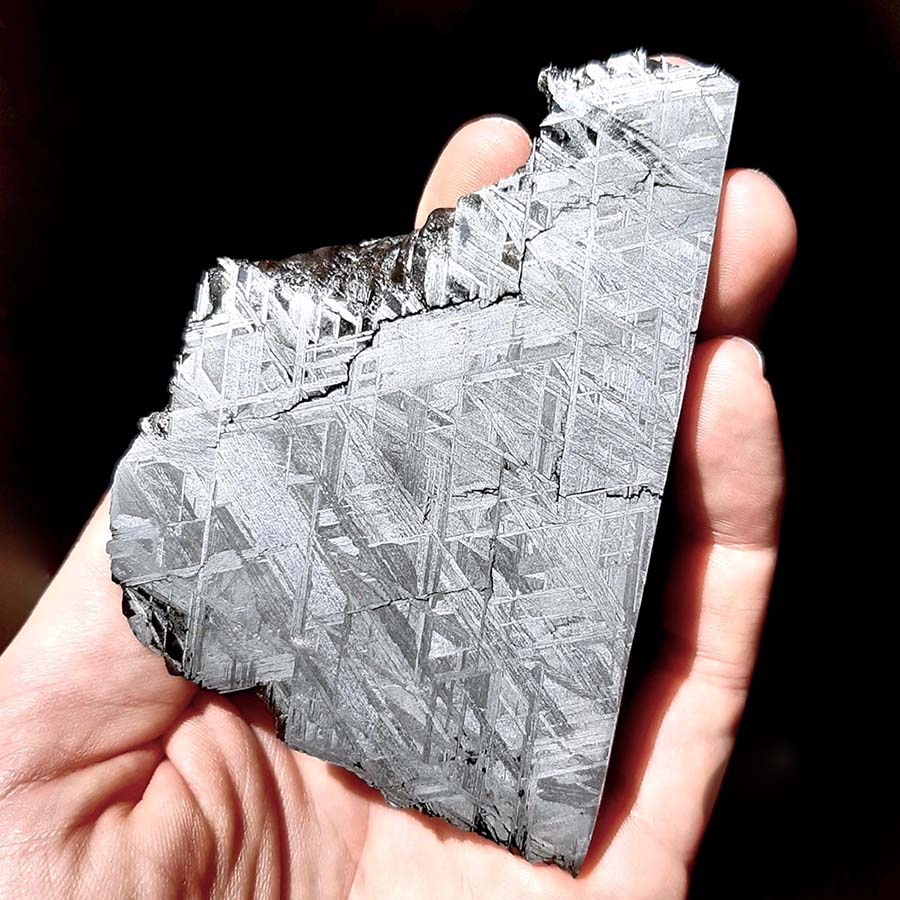
Octahedrites

They display lines (most easily visible after polishing and etching) which are called Widmanstatten pattern. The Widmanstatten pattern reflects light from different angles due to differences in the crystallization of kamacite and taenite minerals. This is the result of the cooling-down of an asteroid’s core at about 1 degree Celsius every million years. The resulting lines of crystallization form an octahedron (a 3-dimensional shape), from which this type’s name is derived. Some types of octahedrites also display Neumann lines although they are more characteristic of hexahedrites.

Iron meteorites.
Iron octahedrite

Hexahedrites

They display a feature called Neumann lines. These lines are very fine and result from a strong mechanical shock in space due to an impact. Hexahedrites are lower in nickel than octahedrites, usually around 5.5%. When crystallized, kamacite forms right-angled cubic crystals with six sides.

Chemical classes that include hexahedrites are all IIG and some IIAB classifications.

Iron meteorites.
Iron hexahedrite

Ataxites

They are a type of iron meteorite that do not show lines upon etching. Their name means ‘without structure’. Ataxites have >18% nickel content and most of the meteoric iron is kamacite with minor amounts of taenite, so no structural difference can be seen when they are cut and etched.

Iron meteorites.
Iron ataxite

Additional resources

Click on the link to learn about impactites: Information About Impactites.


For a detailed guide on identifying meteorites visit: How to Identify a Meteorite.


To the main page: Shop.

×